
REPORT ON 2007 FAI FREE FLIGHT WORLD CUP
by Ian Kaynes Chairman, CIAM FF Subcommittee December 2007
2007 saw the introduction of two new classes in the Free Flight World Cup. The F1B category was extended to have a Junior classification and a new category was introduced for F1Q (electric models). The numbers of competitions in the main class in 2007 were identical to the numbers in 2006, which had been the largest ever, but with additional participation of Juniors in F1A at 3 more events and also 33 events in which Juniors flew in the new category of F1B Juniors. There were 5 competitions for F1Q, 4 e being alongside established competitions and one new event, but very few entries in each competition.
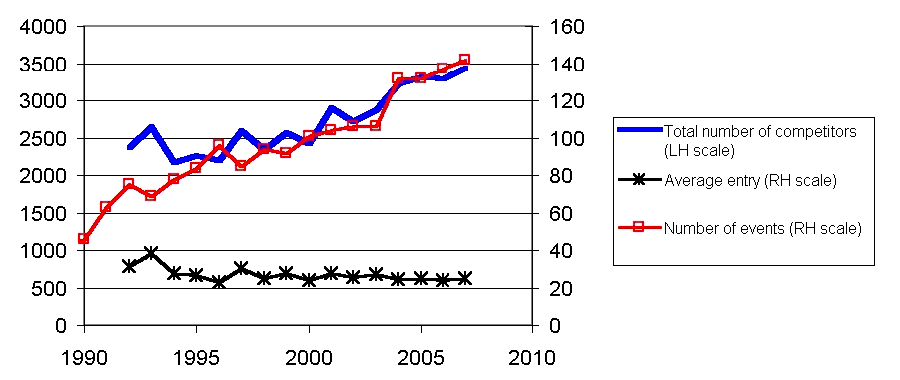
In the course of adding the new junior event to the statistics, it was found that under the method used previously a few junior competitors had been counted twice in the deriving the total number of participants. The total number of participants in 2007 was the greatest ever both under the old procedure and also by the exact count, which gives 3435. The historical growth of the exact number of competitors is shown in the following plot. Also shown is the number of events (counting F1A, F1B, F1C, F1Q, and F1E, not including junior classifications) and also the average entry in each event over these classes. It is seen that the total number of competitors almost exactly follows the number of events, while the average entry in each event has declined very slightly as new, smaller events have been added.
The F1A World Cup was retained by the 2006 winner, Roland Koglot from Slovenia. His score was aided by bonus points from wins at the large Puszta Cup and Poitou contests, retaining a single point advantage over Mikhail Kosonozhkin (Russia) who finished strongly with wins in the last two competitions of the season (Krka Cup and Euro Fly). Third place went to Per Findahl, who recorded "only" one win this year. F1A Junior was won by Janis Zarins of Latvia, the runner up in 2006, with a clear margin over Martin Meislalu (Estonia) and Tamas Horvath (Hungary) in second and third place.
F1B was also won by the runner-up in 2006, Ivan Kolic from Serbia. Igor Vivchar (Ukraine) was second and the 2006 winner Bernd Silz was third. The top three flyers in the new Junior category of F1B all scored 150 points. The winner was Oskar Findahl (Sweden) with victories in 5 competitions, ahead of second and third place flyers with three wins each. The greater number of entries in the events he had won gave the silver position to Oleksandr Kulakovsy (Ukraine) over Mariana Savov of Bulgaria.
The 2006 runner-up also won F1C, Reinhard Truppe from Austria with 8 wins and finishing in points positions at another 8 events. Although they shared the same number of points, Truppe's number of wins beat Eugene Verbitsky (Ukraine) into second place. In third place was Gabor Zsengeller of Hungary.
The first World Cup for F1Q was won by Frank Pollard (USA) with wins at both of the competitions in USA. Second place went to Teppo Sarpila of Finland, the only other competitor to score points at two competitions. Trevor Grey (GBR) and Andreas Lindner (GER) tied in third place with single wins.
The top three places in F1E were decided by bonus points between three flyers each with best results of two wins and a second place. Marian Popescu (Romania) took the honours in front of Ivan Treger (Slovakia) and Fritz Mang (Austria). F1E Junior was won by Dominika Drmlova (Slovakia), second place Monkia Sowa (Poland) and third place Jakub Drmla (Slovakia).
ORGANISATION
This year it was notable that three planned competitions were not held. Holiday on Ice in Norway was cancelled because of high winds and a very slippery surface on the frozen lake. The Favli competition in Italy was cancelled. Von Hafe Cup in Portugal was not held because no entries had been received.
There were still some competitions which failed to provide FAI licence numbers for each competitor. When this is done it greatly aids recognition of a competitor given that spelling of names often varies between competitions - and also confirms that the organisers have checked the licences. As usual there were a few problems of names of competitors in different events not being recognised as one person or of junior status not being recorded, which is easily corrected when notified by the competitor.
There has been a letter to the FAI noting that some events were not run according to the Sporting Code. In general the control of observation of the code is delegated to the FAI Jury at the event. There has often been feedback from competitors when there has been a problem, sometimes not mentioned in the Jury report, resulting in a request to the organisers to improve that aspect for the following year. In some cases it seems that a more objective Jury report would be useful. Jury reports have been received for the large majority of the events (a total of 48, all available on the FF World Cup web site and linked to the contest results) and these have described the deviations from the standard Sporting Code. The following list shows the items reported as deviations from the Sporting Code and some other incidents in F1A,B,C,Q:
| Philippe Lepage | FRA | First flight 210 sec, first flyoff 420 sec Continual pressure applied to the timekeepers and contest director by the helper of competitor Kolic |
| Bear Cup | FIN | No jury report, results show 5 rounds flown |
| Matfors VT | SWE | Timekeeping made by competitors. Only one timekeeper/contestant in F1A flyoff |
| AFFS Champs | AUS | Competitors to time others |
| Southern Cross | AUS | Competitors timed for each other. Check timing by CD. |
| Istanbul Cup | TUR | 240 sec. flight time for F1A in the 1st round |
| Embalse | ARG | No jury report, results showed 5 rounds flown in F1A and F1C |
| Srem Cup | SRB | 210 sec maximum in last round |
| Stonehenge Cup | GBR | Competition was advertised to have only 5 rounds. In the event F1A had to be further curtailed to 3 rounds as a result of the bad weather. |
| Swedish Cup | SWE | Competitors were timing each other, Timing check was randomly preformed by the contest organisation. In fly-off organiser named the timekeepers 5 rounds flown |
| Nordic Cup | DEN | Competitors were timing each other, Timing check was randomly preformed on the starting line by the contest organisation. 5 rounds flown |
| Puszta Cup | HUN | Round 7 maximum 240 sec |
| Djorde Zidic | SRB | No jury report, results show 5 rounds flown |
| Black Sea Cup | UKR | 5 rounds for F1A, B and C |
| Antonov Cup | UKR | F1A,B,C 5 rounds instead 7 ones, round 1 - 2 min 30 sec, rounds 2,3,4,5 - 2 min because of gusty wind and rain conditions |
| Black Cup | POL | 5 rounds flown |
| US Nationals Electric | USA | Flew with a 15-second motor run flown in rounds. The National's contest director required a 25-second motor run and non-round flying. Consequently, one flier who followed these rules was disqualified. Issues with the Nationals organizers regarding two sets of F1Q rules. Competitors timing each other. |
| Negev Open | ISR | F1B round 2 maximum 300 sec |
| Sierra Cup | USA | A time your pole mates contest (fly one and time one) with no controversy noted, including F1C engine timing. |
| Euro Fly | SUI | The rules had to be slightly changed due to the local weather and environment conditions. The farmland had to be protected as far as possible. (5 rounds flown) |
It is noted that the two most common features are flying competitions to 5 rounds instead of 7 and using competitors to time one another instead of providing a full staff of official timekeepers. Both are acceptable solutions to the specific problems of sites and providing timekeepers, but the intended plans should be announced in advance. This has been the case for almost all the instances recorded above. Apart from these direct deviations from the Sporting Code, a large part of successful event on the field results from a helpful attitude by the organiser, sensible decisions and effective communications with the competitor - difficult to measure apart from competitive experience of the specific events. The deviation not recorded is in checking FAI licences, but the results list shows contests which did include licence numbers with their results as requested.
In F1E the only deviations recorded were four events noted that a 5 min working time was used, which is common at F1E events and California Cup was flown to 8 flights instead of 5 (by prior announcement, done to compensate for the small height of the hill).
There were no World Cup protests this year, but there have been some complaints after competitions about pressure applied to the timekeepers by particular people.
STATISTICS
Note about the inclusion of juniors in these statistics: The individual events F1A, F1A-Junior, etc show the numbers relevant to that event. The column headed ALL is the total of number of competitors in the full events (F1A B C E Q) which takes account of the fact that juniors have also been included in the results of the full event.
Number of competitors per country, only those scoring points in 2 or more events:
|
F1A |
F1A junior |
F1B |
F1B junior |
F1C |
F1Q |
F1E |
F1E junior |
All |
|||||||||
| HUN | 11 | EST | 3 | GER | 10 | LTU | 2 | GER | 7 | FIN | 1 | ROU | 8 | FRA | 3 | GER | 33 |
| GER | 10 | HUN | 3 | UKR | 10 | BIH | 1 | UKR | 5 | USA | 1 | ITA | 6 | HUN | 3 | UKR | 23 |
| SVK | 10 | LAT | 3 | USA | 10 | BUL | 1 | GBR | 4 | CZE | 5 | POL | 3 | HUN | 22 | ||
| NED | 8 | SLO | 3 | RUS | 6 | GER | 1 | HUN | 4 | AUT | 4 | SVK | 3 | USA | 21 | ||
| FIN | 7 | UKR | 3 | NED | 5 | LAT | 1 | RUS | 4 | POL | 4 | AUT | 1 | SVK | 19 | ||
| RUS | 7 | BIH | 2 | CRO | 4 | POL | 1 | USA | 4 | SVK | 4 | CZE | 1 | POL | 17 | ||
| UKR | 7 | SVK | 2 | SWE | 4 | SWE | 1 | AUT | 2 | FRA | 3 | GER | 1 | RUS | 17 | ||
| EST | 6 | SRB | 2 | BIH | 3 | UKR | 1 | BIH | 2 | GER | 3 | ROU | 1 | FRA | 16 | ||
| FRA | 6 | BUL | 1 | CZE | 3 | SRB | 1 | BUL | 2 | NED | 14 | ||||||
| SLO | 6 | FRA | 1 | FIN | 3 | LTU | 2 | AUT | 13 | ||||||||
| SWE | 6 | GER | 1 | GBR | 3 | SLO | 2 | CZE | 13 | ||||||||
| POL | 5 | NED | 1 | HUN | 3 | AUS | 1 | FIN | 12 | ||||||||
| USA | 5 | POL | 1 | LTU | 3 | CRO | 1 | ITA | 10 | ||||||||
| AUT | 4 | RUS | 1 | TUR | 3 | CZE | 1 | ROU | 10 | ||||||||
| BIH | 4 | USA | 1 | AUS | 2 | EST | 1 | SWE | 10 | ||||||||
| CRO | 4 | AUT | 2 | FIN | 1 | BIH | 9 | ||||||||||
| ARG | 3 | FRA | 2 | FRA | 1 | CRO | 9 | ||||||||||
| BUL | 3 | ITA | 2 | ITA | 1 | EST | 9 | ||||||||||
| CZE | 3 | POL | 2 | LAT | 1 | GBR | 9 | ||||||||||
| LTU | 3 | SUI | 2 | NED | 1 | LTU | 9 | ||||||||||
| TUR | 3 | SRB | 2 | POL | 1 | SLO | 9 | ||||||||||
| SRB | 3 | BUL | 1 | SRB | 1 | BUL | 8 | ||||||||||
| AUS | 2 | CAN | 1 | SRB | 8 | ||||||||||||
| GBR | 2 | EST | 1 | LAT | 7 | ||||||||||||
| ISR | 2 | GEO | 1 | TUR | 6 | ||||||||||||
| LAT | 2 | LAT | 1 | AUS | 5 | ||||||||||||
| SUI | 2 | SLO | 1 | SUI | 4 | ||||||||||||
| CAN | 1 | ARG | 3 | ||||||||||||||
| DEN | 1 | CAN | 2 | ||||||||||||||
| ITA | 1 | ISR | 2 | ||||||||||||||
| LUX | 1 | DEN | 1 | ||||||||||||||
| MKD | 1 | GEO | 1 | ||||||||||||||
| NOR | 1 | LUX | 1 | ||||||||||||||
| ROU | 1 | MKD | 1 | ||||||||||||||
| ESP | 1 | NOR | 1 | ||||||||||||||
| ESP | 1 | ||||||||||||||||
F1A |
F1AJ |
F1B |
F1BJ |
F1C |
F1Q |
F1E |
F1EJ |
|
| Number of competitions | 41 | 36 | 41 | 32 | 38 | 5 | 17 | 16 |
| Total number of entries | 1558 | 247 | 881 | 88 | 422 | 14 | 560 | 140 |
| Number of competitors scoring points: | ||||||||
| in 1 event | 234 | 54 | 124 | 21 | 60 | 4 | 41 | 8 |
| in 2 events | 81 | 15 | 41 | 4 | 27 | 2 | 22 | 4 |
| in 3 events | 25 | 5 | 20 | 1 | 10 | 0 | 12 | 3 |
| in 4 events | 17 | 5 | 12 | 3 | 4 | 0 | 7 | 4 |
| in 5 events | 8 | 2 | 6 | 1 | 3 | 0 | 2 | 1 |
| in 6 events | 7 | 0 | 4 | 1 | 2 | 0 | 2 | 1 |
| in 7 events | 1 | 1 | 3 | 0 | 1 | 0 | 5 | 3 |
| in 8 events | 0 | 0 | 2 | 0 | 0 | 0 | 2 | 0 |
| in 9 events | 0 | 0 | 1 | 0 | 0 | 0 | 1 | 0 |
| in 10 events | 1 | 0 | 0 | 0 | 1 | 0 | 2 | 0 |
| in 11 events | 1 | 0 | 0 | 0 | 0 | 0 | 1 | 0 |
| in 12 events | 1 | 0 | 0 | 0 | 0 | 0 | 0 | 0 |
| in 13 events | 0 | 0 | 0 | 0 | 0 | 0 | 0 | 0 |
| in 14 events | 0 | 0 | 1 | 0 | 0 | 0 | 0 | 0 |
| in 15 events | 0 | 0 | 0 | 0 | 0 | 0 | 0 | 0 |
| in 16 events | 0 | 0 | 0 | 0 | 1 | 0 | 0 | 0 |
| Total number of competitors scoring World Cup points | 376 | 82 | 215 | 31 | 110 | 6 | 97 | 24 |
Total number of participants in all classes: 3435
[Aeromodelling Commission] - [FF World Cup rules 2007] - [FF World Cup results index]
This page produced by Ian Kaynes